Review


plko.1-trc cloning vectors carrying the shrnas sequence  (Millipore)


Bioz Verified Symbol Millipore is a verified supplier  
  • Logo
  • About
  • News
  • Press Release
  • Team
  • Advisors
  • Partners
  • Contact
  • Bioz Stars
  • Bioz vStars
  • 90

    Structured Review

    Millipore plko.1-trc cloning vectors carrying the shrnas sequence
    A : Representation of <t>the</t> <t>pLKO.1-TRC</t> cloning vector encoding one of three different <t>shRNAs</t> (either scrambled, sh535, or sh380) and the enhanced green fluorescent protein (EGFP). The expression of shRNAs is driven by the hU6 promoter. Ampicillin resistance was used for plasmid selection. B : The graph shows the percentage of lentivirally transduced astrocytes assessed by high-throughput microscopy; n=10107 cells for scrambled, 9771 for sh535, and 8263 for sh380, from 5 biological replicates; each dot represents the mean percentage of transduced cells in a single culture well. C : Western blot of protein lysates derived from wt, scrambled-, sh535- and sh380-transduced astrocytes, immunostained with antibodies detecting FXN (15kDa). GFP (25kDa) was used to assess the transduction efficiency; ɑ-tubulin (50kDa) was used as a loading control. D : FXN protein levels, normalized to ɑ-tubulin levels, in scrambled-, sh535-, and sh380-transduced astrocytes, compared to wt astrocytes. Data are expressed as mean +/- SEM; n=6; Kruskal-Wallis test; *: p<0.05, **: p<0.01. E : Fxn mRNA levels, normalized to β-actin, in scrambled- and sh380-transduced astrocytes, determined by RT-qPCR compared to wt. Data are expressed as mean +/- SEM; n=3; Brown-Forsythe and Welch ANOVA tests; *p<0.05
    Plko.1 Trc Cloning Vectors Carrying The Shrnas Sequence, supplied by Millipore, used in various techniques. Bioz Stars score: 90/100, based on 1 PubMed citations. ZERO BIAS - scores, article reviews, protocol conditions and more
    https://www.bioz.com/result/plko.1-trc cloning vectors carrying the shrnas sequence/product/Millipore
    Average 90 stars, based on 1 article reviews
    plko.1-trc cloning vectors carrying the shrnas sequence - by Bioz Stars, 2026-05
    90/100 stars

    Images

    1) Product Images from "Altered calcium responses and antioxidant properties in Friedreich’s ataxia-like cerebellar astrocytes"

    Article Title: Altered calcium responses and antioxidant properties in Friedreich’s ataxia-like cerebellar astrocytes

    Journal: bioRxiv

    doi: 10.1101/2024.07.19.604129

    A : Representation of the pLKO.1-TRC cloning vector encoding one of three different shRNAs (either scrambled, sh535, or sh380) and the enhanced green fluorescent protein (EGFP). The expression of shRNAs is driven by the hU6 promoter. Ampicillin resistance was used for plasmid selection. B : The graph shows the percentage of lentivirally transduced astrocytes assessed by high-throughput microscopy; n=10107 cells for scrambled, 9771 for sh535, and 8263 for sh380, from 5 biological replicates; each dot represents the mean percentage of transduced cells in a single culture well. C : Western blot of protein lysates derived from wt, scrambled-, sh535- and sh380-transduced astrocytes, immunostained with antibodies detecting FXN (15kDa). GFP (25kDa) was used to assess the transduction efficiency; ɑ-tubulin (50kDa) was used as a loading control. D : FXN protein levels, normalized to ɑ-tubulin levels, in scrambled-, sh535-, and sh380-transduced astrocytes, compared to wt astrocytes. Data are expressed as mean +/- SEM; n=6; Kruskal-Wallis test; *: p<0.05, **: p<0.01. E : Fxn mRNA levels, normalized to β-actin, in scrambled- and sh380-transduced astrocytes, determined by RT-qPCR compared to wt. Data are expressed as mean +/- SEM; n=3; Brown-Forsythe and Welch ANOVA tests; *p<0.05
    Figure Legend Snippet: A : Representation of the pLKO.1-TRC cloning vector encoding one of three different shRNAs (either scrambled, sh535, or sh380) and the enhanced green fluorescent protein (EGFP). The expression of shRNAs is driven by the hU6 promoter. Ampicillin resistance was used for plasmid selection. B : The graph shows the percentage of lentivirally transduced astrocytes assessed by high-throughput microscopy; n=10107 cells for scrambled, 9771 for sh535, and 8263 for sh380, from 5 biological replicates; each dot represents the mean percentage of transduced cells in a single culture well. C : Western blot of protein lysates derived from wt, scrambled-, sh535- and sh380-transduced astrocytes, immunostained with antibodies detecting FXN (15kDa). GFP (25kDa) was used to assess the transduction efficiency; ɑ-tubulin (50kDa) was used as a loading control. D : FXN protein levels, normalized to ɑ-tubulin levels, in scrambled-, sh535-, and sh380-transduced astrocytes, compared to wt astrocytes. Data are expressed as mean +/- SEM; n=6; Kruskal-Wallis test; *: p<0.05, **: p<0.01. E : Fxn mRNA levels, normalized to β-actin, in scrambled- and sh380-transduced astrocytes, determined by RT-qPCR compared to wt. Data are expressed as mean +/- SEM; n=3; Brown-Forsythe and Welch ANOVA tests; *p<0.05

    Techniques Used: Clone Assay, Plasmid Preparation, Expressing, Selection, High Throughput Screening Assay, Microscopy, Western Blot, Derivative Assay, Transduction, Control, Quantitative RT-PCR


    Similar Products

    96
    Broad Clinical Labs trc shrna design
    A) Timeline of <t>shRNA</t> infection and analysis of mRNA and protein expression. B) Western blot shows expression of eIF3B protein in Ocy454 cells at differentiation day 7 following stable infection with the indicated shRNAs. C) mRNA expression of Eif3b in Ocy454 cells at differentiation day 7 following stable infection with the indicated shRNAs. Line shows median of three biologic replicates. *p<0.05. D) Flow cytometry results show percent of cells labeled with CD61-PE antibody compared to isotype control at a range of differentiation timepoints following stable infection with the indicated shRNAs. Error bars show standard deviation for all replicates at each time point. E) mRNA expression of Itgb3 in Ocy454 cells at differentiation day 10 following stable infection with the indicated shRNAs. Line shows median of three biologic replicates. *p<0.05. F) Histograms show intensity of CD61-PE fluorescence compared to isotype control at differentiation day 7 for cells stably expressing FLuc-targeting shRNA and Itgb3-targeting shRNA. G) Histograms show intensity of CD61-PE fluorescence compared to isotype control at differentiation day 7 for cells stably expressing FLuc-targeting shRNA and Itgb3-targeting shRNA.
    Trc Shrna Design, supplied by Broad Clinical Labs, used in various techniques. Bioz Stars score: 96/100, based on 1 PubMed citations. ZERO BIAS - scores, article reviews, protocol conditions and more
    https://www.bioz.com/result/trc shrna design/product/Broad Clinical Labs
    Average 96 stars, based on 1 article reviews
    trc shrna design - by Bioz Stars, 2026-05
    96/100 stars
      Buy from Supplier

    93
    Addgene inc shrna targeting sequence
    A Immunoblot of s-EVs from mouse lung tissues after fractionation by sucrose density ultracentrifugation and probed for ALIX, GLUD1 and TOMM40. Experiment was repeated independently three times with similar results. B Transmission electron microscopy (TEM) images of s-EVs isolated from lung tissues from Sftpc cre Gprc5a fl/fl and Sftpc cre Gprc5a wt/wt mice. Scale bar, 200 nm. C Size distributions of s-EVs from lungs of Sftpc cre Gprc5a fl/fl and Sftpc cre Gprc5a wt/wt mice (means ± SEM, n = 3 replicates per group). D , E ( D ) Immunoblot of cell lysates and s-EV lysates prepared from Sftpc cre Gprc5a wt/wt and Sftpc cre Gprc5a fl/fl lungs. S-EVs lysates were probed for GLUD1, TOMM40 and ALIX. Cell lysates were probed for GLUD1, TOMM40, ALIX and β-actin. E Quantification of relative GLUD1 and TOMM40 densities (normalized to ALIX) in s-EVs (means ± SEM, n = 4 mice). F TEM images of s-EVs isolated from cell culture supernatants of knockdown GPRC5A (shGPRC5A-#1 and #2) or control (shCTL) A549 cells. Scale bar, 100 nm. G Size distributions of s-EVs from cell culture supernatants of knockdown GPRC5A (shGPRC5A-#1 and #2) or control (shCTL) A549 cells (means ± SEM, n = 3 replicates per group). H Immunoblot of cell lysates and s-EV lysates prepared from supernatants of the same number of knockdown GPRC5A (shGPRC5A #1 and #2) and control (shCTL) A549 cells. S-EVs lysates were probed for GLUD1, TOMM40 and ALIX. Cell lysates were probed for GLUD1, TOMM40, ALIX and β-actin. I Quantification of relative GLUD1 and TOMM40 densities (normalized to ALIX) in s-EVs (means ± SEM, n = 3 independent experiments). J A549 cells stably expressing MitoDsRed and GFP-CD63 were infected with <t>GPRC5A-shRNA</t> (shGPRC5A), or <t>control</t> <t>lentiviral</t> constructs (shCTL). S-EVs were collected from indicated culture supernatants and analyzed by flow cytometry. K Percentage of MitoDsRed + particles in all CD63 + s-EVs and ( L ) absolute number of CD63 + MitoDsRed + s-EVs (normalized to cell number) were quantified (means ± SEM, n = 3 independent experiments). Statistical significance was assessed using a two-tailed unpaired Student’s t test in ( E , I , and K – L ). Source data are provided as a Source Data file.
    Shrna Targeting Sequence, supplied by Addgene inc, used in various techniques. Bioz Stars score: 93/100, based on 1 PubMed citations. ZERO BIAS - scores, article reviews, protocol conditions and more
    https://www.bioz.com/result/shrna targeting sequence/product/Addgene inc
    Average 93 stars, based on 1 article reviews
    shrna targeting sequence - by Bioz Stars, 2026-05
    93/100 stars
      Buy from Supplier

    96
    Addgene inc nontargeting scramble shrna sequence oligonucleotide gcgcgatagcgctaataattt
    A Immunoblot of s-EVs from mouse lung tissues after fractionation by sucrose density ultracentrifugation and probed for ALIX, GLUD1 and TOMM40. Experiment was repeated independently three times with similar results. B Transmission electron microscopy (TEM) images of s-EVs isolated from lung tissues from Sftpc cre Gprc5a fl/fl and Sftpc cre Gprc5a wt/wt mice. Scale bar, 200 nm. C Size distributions of s-EVs from lungs of Sftpc cre Gprc5a fl/fl and Sftpc cre Gprc5a wt/wt mice (means ± SEM, n = 3 replicates per group). D , E ( D ) Immunoblot of cell lysates and s-EV lysates prepared from Sftpc cre Gprc5a wt/wt and Sftpc cre Gprc5a fl/fl lungs. S-EVs lysates were probed for GLUD1, TOMM40 and ALIX. Cell lysates were probed for GLUD1, TOMM40, ALIX and β-actin. E Quantification of relative GLUD1 and TOMM40 densities (normalized to ALIX) in s-EVs (means ± SEM, n = 4 mice). F TEM images of s-EVs isolated from cell culture supernatants of knockdown GPRC5A (shGPRC5A-#1 and #2) or control (shCTL) A549 cells. Scale bar, 100 nm. G Size distributions of s-EVs from cell culture supernatants of knockdown GPRC5A (shGPRC5A-#1 and #2) or control (shCTL) A549 cells (means ± SEM, n = 3 replicates per group). H Immunoblot of cell lysates and s-EV lysates prepared from supernatants of the same number of knockdown GPRC5A (shGPRC5A #1 and #2) and control (shCTL) A549 cells. S-EVs lysates were probed for GLUD1, TOMM40 and ALIX. Cell lysates were probed for GLUD1, TOMM40, ALIX and β-actin. I Quantification of relative GLUD1 and TOMM40 densities (normalized to ALIX) in s-EVs (means ± SEM, n = 3 independent experiments). J A549 cells stably expressing MitoDsRed and GFP-CD63 were infected with <t>GPRC5A-shRNA</t> (shGPRC5A), or <t>control</t> <t>lentiviral</t> constructs (shCTL). S-EVs were collected from indicated culture supernatants and analyzed by flow cytometry. K Percentage of MitoDsRed + particles in all CD63 + s-EVs and ( L ) absolute number of CD63 + MitoDsRed + s-EVs (normalized to cell number) were quantified (means ± SEM, n = 3 independent experiments). Statistical significance was assessed using a two-tailed unpaired Student’s t test in ( E , I , and K – L ). Source data are provided as a Source Data file.
    Nontargeting Scramble Shrna Sequence Oligonucleotide Gcgcgatagcgctaataattt, supplied by Addgene inc, used in various techniques. Bioz Stars score: 96/100, based on 1 PubMed citations. ZERO BIAS - scores, article reviews, protocol conditions and more
    https://www.bioz.com/result/nontargeting scramble shrna sequence oligonucleotide gcgcgatagcgctaataattt/product/Addgene inc
    Average 96 stars, based on 1 article reviews
    nontargeting scramble shrna sequence oligonucleotide gcgcgatagcgctaataattt - by Bioz Stars, 2026-05
    96/100 stars
      Buy from Supplier

    90
    Azenta 0.4 kb flp-1 promoter sequence from pcs169 (flp-1p(trc) :: ice
    ( A ) Measurement of the CCR. C . elegans partially constrained within a microfluidic channel . a: anterior region, p: posterior region, c: constrained middle region. For each strain, the normalized anterior curvature change is equal to the anterior curvature amplitude during microfluidic constraint minus the anterior curvature amplitude of freely moving worms, divided by the anterior curvature amplitude of freely moving worms. hlh-15(tm1824) and hlh-15(ot1389) null mutants display defects in their CCR. These defects are similar to those observed upon genetic ablation of AVK using a transgenic <t>array,</t> <t>zxIs28[flp-1p(trc)</t> :: <t>ICE;</t> myo-2p :: mCherry] , in which the ICE caspase was driven by an AVK-specific flp-1 promoter . N ≥ 10 animals per condition. Error bars indicate mean ± SEM. *** P < 0.001, Dunnett’s multiple comparison tests. ( B ) hlh-15(tm1824) and hlh-15(ot1389) null mutants show increased lifespan. Survival plot of N2, hlh-15(tm1824) , and hlh-15(ot1389) animals. ( C ) hlh-15/NHLH null mutations attenuate the reduction in pharyngeal pumping rate associated with aging. Quantification of pharyngeal pumping rate for N2, hlh-15(ot1389) , and hlh-15(tm1824) at day 1 young adult and day 11 aged adult animals . ( D ) Day 1 adult hlh-15/NHLH null mutants show reduced size of hypodermal cell nucleoli, a prospective hallmark of longevity. Representative DIC images of hypodermal nucleoli (yellow stippled lines; within nucleus, circled with red stippled line) and measurements of nucleolar size for N2, hlh-15(ot1389) , and hlh-15(tm1824) are shown with 10 μm scale bar. The quantification panel on the left shows the size of individual hypodermal nucleoli while the panel on the right shows average hypodermal nucleolar size for each animal. ( E ) Lifespan extension defects of hlh-15(ot1389) mutants are rescued by expressing hlh-15/NHLH selectively in the AVK neurons ( flp-1p :: hlh-15) . Survival plot of N2, hlh-15(ot1389) , and 2 independent transgenic lines ( otEx8247 and otEx8248) of hlh-15(ot1389) animals expressing genomic hlh-15 DNA specifically in AVK. This assay could not be performed with the AVK::ICE lines because animals had a sick appearance. ( F ) Removal of neuropeptide processing in AVK neurons extends lifespan. Survival plot of floxed egl-3(nu1711) animals with the transgene ( kyEx6532 ) or without the transgene (siblings) that expresses Cre recombinase specifically in AVK. For panels B, G, and H, statistics were performed using Log-Rank Test followed by Bonferroni corrections. N = 105 for each strain. All lifespan assays were replicated twice, with a repeat experiment for each shown in . Mean and 75% mortality lifespan tables can be found in . For panel C, two-way ANOVA was performed, while for panels E and F, one-way ANOVA was performed, followed by Bonferroni correction. Raw data for panels A–F can be found in . CCR, compensatory curvature response; DIC, differential interference contrast.
    0.4 Kb Flp 1 Promoter Sequence From Pcs169 (Flp 1p(trc) / Ice, supplied by Azenta, used in various techniques. Bioz Stars score: 90/100, based on 1 PubMed citations. ZERO BIAS - scores, article reviews, protocol conditions and more
    https://www.bioz.com/result/0.4 kb flp-1 promoter sequence from pcs169 (flp-1p(trc) :: ice/product/Azenta
    Average 90 stars, based on 1 article reviews
    0.4 kb flp-1 promoter sequence from pcs169 (flp-1p(trc) :: ice - by Bioz Stars, 2026-05
    90/100 stars
      Buy from Supplier

    96
    Broad Clinical Labs rnai consortium trc version 1 library
    ( A ) Measurement of the CCR. C . elegans partially constrained within a microfluidic channel . a: anterior region, p: posterior region, c: constrained middle region. For each strain, the normalized anterior curvature change is equal to the anterior curvature amplitude during microfluidic constraint minus the anterior curvature amplitude of freely moving worms, divided by the anterior curvature amplitude of freely moving worms. hlh-15(tm1824) and hlh-15(ot1389) null mutants display defects in their CCR. These defects are similar to those observed upon genetic ablation of AVK using a transgenic <t>array,</t> <t>zxIs28[flp-1p(trc)</t> :: <t>ICE;</t> myo-2p :: mCherry] , in which the ICE caspase was driven by an AVK-specific flp-1 promoter . N ≥ 10 animals per condition. Error bars indicate mean ± SEM. *** P < 0.001, Dunnett’s multiple comparison tests. ( B ) hlh-15(tm1824) and hlh-15(ot1389) null mutants show increased lifespan. Survival plot of N2, hlh-15(tm1824) , and hlh-15(ot1389) animals. ( C ) hlh-15/NHLH null mutations attenuate the reduction in pharyngeal pumping rate associated with aging. Quantification of pharyngeal pumping rate for N2, hlh-15(ot1389) , and hlh-15(tm1824) at day 1 young adult and day 11 aged adult animals . ( D ) Day 1 adult hlh-15/NHLH null mutants show reduced size of hypodermal cell nucleoli, a prospective hallmark of longevity. Representative DIC images of hypodermal nucleoli (yellow stippled lines; within nucleus, circled with red stippled line) and measurements of nucleolar size for N2, hlh-15(ot1389) , and hlh-15(tm1824) are shown with 10 μm scale bar. The quantification panel on the left shows the size of individual hypodermal nucleoli while the panel on the right shows average hypodermal nucleolar size for each animal. ( E ) Lifespan extension defects of hlh-15(ot1389) mutants are rescued by expressing hlh-15/NHLH selectively in the AVK neurons ( flp-1p :: hlh-15) . Survival plot of N2, hlh-15(ot1389) , and 2 independent transgenic lines ( otEx8247 and otEx8248) of hlh-15(ot1389) animals expressing genomic hlh-15 DNA specifically in AVK. This assay could not be performed with the AVK::ICE lines because animals had a sick appearance. ( F ) Removal of neuropeptide processing in AVK neurons extends lifespan. Survival plot of floxed egl-3(nu1711) animals with the transgene ( kyEx6532 ) or without the transgene (siblings) that expresses Cre recombinase specifically in AVK. For panels B, G, and H, statistics were performed using Log-Rank Test followed by Bonferroni corrections. N = 105 for each strain. All lifespan assays were replicated twice, with a repeat experiment for each shown in . Mean and 75% mortality lifespan tables can be found in . For panel C, two-way ANOVA was performed, while for panels E and F, one-way ANOVA was performed, followed by Bonferroni correction. Raw data for panels A–F can be found in . CCR, compensatory curvature response; DIC, differential interference contrast.
    Rnai Consortium Trc Version 1 Library, supplied by Broad Clinical Labs, used in various techniques. Bioz Stars score: 96/100, based on 1 PubMed citations. ZERO BIAS - scores, article reviews, protocol conditions and more
    https://www.bioz.com/result/rnai consortium trc version 1 library/product/Broad Clinical Labs
    Average 96 stars, based on 1 article reviews
    rnai consortium trc version 1 library - by Bioz Stars, 2026-05
    96/100 stars
      Buy from Supplier

    96
    Addgene inc target sequence
    ( A ) Measurement of the CCR. C . elegans partially constrained within a microfluidic channel . a: anterior region, p: posterior region, c: constrained middle region. For each strain, the normalized anterior curvature change is equal to the anterior curvature amplitude during microfluidic constraint minus the anterior curvature amplitude of freely moving worms, divided by the anterior curvature amplitude of freely moving worms. hlh-15(tm1824) and hlh-15(ot1389) null mutants display defects in their CCR. These defects are similar to those observed upon genetic ablation of AVK using a transgenic <t>array,</t> <t>zxIs28[flp-1p(trc)</t> :: <t>ICE;</t> myo-2p :: mCherry] , in which the ICE caspase was driven by an AVK-specific flp-1 promoter . N ≥ 10 animals per condition. Error bars indicate mean ± SEM. *** P < 0.001, Dunnett’s multiple comparison tests. ( B ) hlh-15(tm1824) and hlh-15(ot1389) null mutants show increased lifespan. Survival plot of N2, hlh-15(tm1824) , and hlh-15(ot1389) animals. ( C ) hlh-15/NHLH null mutations attenuate the reduction in pharyngeal pumping rate associated with aging. Quantification of pharyngeal pumping rate for N2, hlh-15(ot1389) , and hlh-15(tm1824) at day 1 young adult and day 11 aged adult animals . ( D ) Day 1 adult hlh-15/NHLH null mutants show reduced size of hypodermal cell nucleoli, a prospective hallmark of longevity. Representative DIC images of hypodermal nucleoli (yellow stippled lines; within nucleus, circled with red stippled line) and measurements of nucleolar size for N2, hlh-15(ot1389) , and hlh-15(tm1824) are shown with 10 μm scale bar. The quantification panel on the left shows the size of individual hypodermal nucleoli while the panel on the right shows average hypodermal nucleolar size for each animal. ( E ) Lifespan extension defects of hlh-15(ot1389) mutants are rescued by expressing hlh-15/NHLH selectively in the AVK neurons ( flp-1p :: hlh-15) . Survival plot of N2, hlh-15(ot1389) , and 2 independent transgenic lines ( otEx8247 and otEx8248) of hlh-15(ot1389) animals expressing genomic hlh-15 DNA specifically in AVK. This assay could not be performed with the AVK::ICE lines because animals had a sick appearance. ( F ) Removal of neuropeptide processing in AVK neurons extends lifespan. Survival plot of floxed egl-3(nu1711) animals with the transgene ( kyEx6532 ) or without the transgene (siblings) that expresses Cre recombinase specifically in AVK. For panels B, G, and H, statistics were performed using Log-Rank Test followed by Bonferroni corrections. N = 105 for each strain. All lifespan assays were replicated twice, with a repeat experiment for each shown in . Mean and 75% mortality lifespan tables can be found in . For panel C, two-way ANOVA was performed, while for panels E and F, one-way ANOVA was performed, followed by Bonferroni correction. Raw data for panels A–F can be found in . CCR, compensatory curvature response; DIC, differential interference contrast.
    Target Sequence, supplied by Addgene inc, used in various techniques. Bioz Stars score: 96/100, based on 1 PubMed citations. ZERO BIAS - scores, article reviews, protocol conditions and more
    https://www.bioz.com/result/target sequence/product/Addgene inc
    Average 96 stars, based on 1 article reviews
    target sequence - by Bioz Stars, 2026-05
    96/100 stars
      Buy from Supplier

    96
    Broad Clinical Labs trc
    ( A ) Measurement of the CCR. C . elegans partially constrained within a microfluidic channel . a: anterior region, p: posterior region, c: constrained middle region. For each strain, the normalized anterior curvature change is equal to the anterior curvature amplitude during microfluidic constraint minus the anterior curvature amplitude of freely moving worms, divided by the anterior curvature amplitude of freely moving worms. hlh-15(tm1824) and hlh-15(ot1389) null mutants display defects in their CCR. These defects are similar to those observed upon genetic ablation of AVK using a transgenic <t>array,</t> <t>zxIs28[flp-1p(trc)</t> :: <t>ICE;</t> myo-2p :: mCherry] , in which the ICE caspase was driven by an AVK-specific flp-1 promoter . N ≥ 10 animals per condition. Error bars indicate mean ± SEM. *** P < 0.001, Dunnett’s multiple comparison tests. ( B ) hlh-15(tm1824) and hlh-15(ot1389) null mutants show increased lifespan. Survival plot of N2, hlh-15(tm1824) , and hlh-15(ot1389) animals. ( C ) hlh-15/NHLH null mutations attenuate the reduction in pharyngeal pumping rate associated with aging. Quantification of pharyngeal pumping rate for N2, hlh-15(ot1389) , and hlh-15(tm1824) at day 1 young adult and day 11 aged adult animals . ( D ) Day 1 adult hlh-15/NHLH null mutants show reduced size of hypodermal cell nucleoli, a prospective hallmark of longevity. Representative DIC images of hypodermal nucleoli (yellow stippled lines; within nucleus, circled with red stippled line) and measurements of nucleolar size for N2, hlh-15(ot1389) , and hlh-15(tm1824) are shown with 10 μm scale bar. The quantification panel on the left shows the size of individual hypodermal nucleoli while the panel on the right shows average hypodermal nucleolar size for each animal. ( E ) Lifespan extension defects of hlh-15(ot1389) mutants are rescued by expressing hlh-15/NHLH selectively in the AVK neurons ( flp-1p :: hlh-15) . Survival plot of N2, hlh-15(ot1389) , and 2 independent transgenic lines ( otEx8247 and otEx8248) of hlh-15(ot1389) animals expressing genomic hlh-15 DNA specifically in AVK. This assay could not be performed with the AVK::ICE lines because animals had a sick appearance. ( F ) Removal of neuropeptide processing in AVK neurons extends lifespan. Survival plot of floxed egl-3(nu1711) animals with the transgene ( kyEx6532 ) or without the transgene (siblings) that expresses Cre recombinase specifically in AVK. For panels B, G, and H, statistics were performed using Log-Rank Test followed by Bonferroni corrections. N = 105 for each strain. All lifespan assays were replicated twice, with a repeat experiment for each shown in . Mean and 75% mortality lifespan tables can be found in . For panel C, two-way ANOVA was performed, while for panels E and F, one-way ANOVA was performed, followed by Bonferroni correction. Raw data for panels A–F can be found in . CCR, compensatory curvature response; DIC, differential interference contrast.
    Trc, supplied by Broad Clinical Labs, used in various techniques. Bioz Stars score: 96/100, based on 1 PubMed citations. ZERO BIAS - scores, article reviews, protocol conditions and more
    https://www.bioz.com/result/trc/product/Broad Clinical Labs
    Average 96 stars, based on 1 article reviews
    trc - by Bioz Stars, 2026-05
    96/100 stars
      Buy from Supplier

    90
    Millipore plko.1-trc cloning vectors carrying the shrnas sequence
    A : Representation of <t>the</t> <t>pLKO.1-TRC</t> cloning vector encoding one of three different <t>shRNAs</t> (either scrambled, sh535, or sh380) and the enhanced green fluorescent protein (EGFP). The expression of shRNAs is driven by the hU6 promoter. Ampicillin resistance was used for plasmid selection. B : The graph shows the percentage of lentivirally transduced astrocytes assessed by high-throughput microscopy; n=10107 cells for scrambled, 9771 for sh535, and 8263 for sh380, from 5 biological replicates; each dot represents the mean percentage of transduced cells in a single culture well. C : Western blot of protein lysates derived from wt, scrambled-, sh535- and sh380-transduced astrocytes, immunostained with antibodies detecting FXN (15kDa). GFP (25kDa) was used to assess the transduction efficiency; ɑ-tubulin (50kDa) was used as a loading control. D : FXN protein levels, normalized to ɑ-tubulin levels, in scrambled-, sh535-, and sh380-transduced astrocytes, compared to wt astrocytes. Data are expressed as mean +/- SEM; n=6; Kruskal-Wallis test; *: p<0.05, **: p<0.01. E : Fxn mRNA levels, normalized to β-actin, in scrambled- and sh380-transduced astrocytes, determined by RT-qPCR compared to wt. Data are expressed as mean +/- SEM; n=3; Brown-Forsythe and Welch ANOVA tests; *p<0.05
    Plko.1 Trc Cloning Vectors Carrying The Shrnas Sequence, supplied by Millipore, used in various techniques. Bioz Stars score: 90/100, based on 1 PubMed citations. ZERO BIAS - scores, article reviews, protocol conditions and more
    https://www.bioz.com/result/plko.1-trc cloning vectors carrying the shrnas sequence/product/Millipore
    Average 90 stars, based on 1 article reviews
    plko.1-trc cloning vectors carrying the shrnas sequence - by Bioz Stars, 2026-05
    90/100 stars
      Buy from Supplier

    92
    Addgene inc shrna sequences targeting elavl
    A : Representation of <t>the</t> <t>pLKO.1-TRC</t> cloning vector encoding one of three different <t>shRNAs</t> (either scrambled, sh535, or sh380) and the enhanced green fluorescent protein (EGFP). The expression of shRNAs is driven by the hU6 promoter. Ampicillin resistance was used for plasmid selection. B : The graph shows the percentage of lentivirally transduced astrocytes assessed by high-throughput microscopy; n=10107 cells for scrambled, 9771 for sh535, and 8263 for sh380, from 5 biological replicates; each dot represents the mean percentage of transduced cells in a single culture well. C : Western blot of protein lysates derived from wt, scrambled-, sh535- and sh380-transduced astrocytes, immunostained with antibodies detecting FXN (15kDa). GFP (25kDa) was used to assess the transduction efficiency; ɑ-tubulin (50kDa) was used as a loading control. D : FXN protein levels, normalized to ɑ-tubulin levels, in scrambled-, sh535-, and sh380-transduced astrocytes, compared to wt astrocytes. Data are expressed as mean +/- SEM; n=6; Kruskal-Wallis test; *: p<0.05, **: p<0.01. E : Fxn mRNA levels, normalized to β-actin, in scrambled- and sh380-transduced astrocytes, determined by RT-qPCR compared to wt. Data are expressed as mean +/- SEM; n=3; Brown-Forsythe and Welch ANOVA tests; *p<0.05
    Shrna Sequences Targeting Elavl, supplied by Addgene inc, used in various techniques. Bioz Stars score: 92/100, based on 1 PubMed citations. ZERO BIAS - scores, article reviews, protocol conditions and more
    https://www.bioz.com/result/shrna sequences targeting elavl/product/Addgene inc
    Average 92 stars, based on 1 article reviews
    shrna sequences targeting elavl - by Bioz Stars, 2026-05
    92/100 stars
      Buy from Supplier

    96
    Broad Clinical Labs trc shrna library
    4A: DTX treatment upregulates CDKN1B expression in a fraction of CTCs. Representative scatter plot showing untreated (NT) and DTX-treated (10nM, day 7) CTCs, stained with antibody against CDKN1B and analyzed by flow cytometry. 4B: Bar graph: (mean ± SEM) increase in CDKN1B-positive cells in DTX-treated per pro CTCs (BRx-68, BRx-82, BRx-142, BRx-211, BRx-250, BRx-292), compared with untreated cells (NT). n=3 biological repeats, with p-value calculated using two-tailed Student’s T-test (** p<0.01). 4C: Suppression of DTPs in per pro CTCs following CDKN1B knockdown using transient siRNA transfection. CTC cultures were transfected with siCDKN1B (red) or siControl (blue), and after three days treated with increasing concentrations of DTX (Knockdown efficiency is show in Supplemetary Figure S4F). Knockdown of CDKN1B decreases the minimal residual fraction of viable CTCs in per pro CTC cultures (BRx-68, BRx-82, BRx-142), but it has no effect in the already low viable cell fraction in per def CTC cultures (BRx07, BRx-29, BRx-394). 1-E max at each DTX dose was measured (n= 3 biological repeats). p-value (p<0.0001 for each of the BRx-68, BRx-82 and BRx-142 CTCs) was calculated using a two-tailed Student’s T-Test. 4D : Stable CDKN1B mRNA knockdown by two different <t>shRNA</t> constructs (sh1B-H3, sh1B-H4), shown using bar graph (mean ± SEM) in per pos CTCs (BRx-82, BRx-142), compared with scrambled control. P-value calculated using two-tailed Student’s T-Test (**** p<0.0001). 4E: CDKN1B knockdown suppresses regrowth of DTPs following pulse DTX treatment of per pro CTCs (BRx-82, BRx-142). Infection of CTC cultures with either sh1B-H3 (red) or sh1B-H4 (green), followed by DTX exposure (10nM, 16 hrs) abolishes the regrowth observed with shScrambled control (blue). A representative graph, from at least two biological repeats, is shown. 4F: CDKN1B knockdown efficiency following siRNA transfection of CTC cultures (BRx-142) is represented by bar graph (mean ± SEM). p-value was calculated using two-tailed Student’s T-Test (*** p<0.01). 4G: Bar graphs (mean ± SEM) showing the quantification of mitotic (pHH3-positive) 4N and ≥8N BRx-142 CTCs, shown for untreated (NT, blue) and DTX-treated (red; 10nM, day 7) cultures, following transfection with either siCDKN1B or siControl. CDKN1B knockdown increases the number of mitotic >8N CTCs following pulse DTX, but not the number of mitotic 4N CTCs. P-value calculated using two-tailed Student’s T-Test (** p<0.01, ***p<0.001). n=3 biological triplicates.
    Trc Shrna Library, supplied by Broad Clinical Labs, used in various techniques. Bioz Stars score: 96/100, based on 1 PubMed citations. ZERO BIAS - scores, article reviews, protocol conditions and more
    https://www.bioz.com/result/trc shrna library/product/Broad Clinical Labs
    Average 96 stars, based on 1 article reviews
    trc shrna library - by Bioz Stars, 2026-05
    96/100 stars
      Buy from Supplier

    Image Search Results


    A) Timeline of shRNA infection and analysis of mRNA and protein expression. B) Western blot shows expression of eIF3B protein in Ocy454 cells at differentiation day 7 following stable infection with the indicated shRNAs. C) mRNA expression of Eif3b in Ocy454 cells at differentiation day 7 following stable infection with the indicated shRNAs. Line shows median of three biologic replicates. *p<0.05. D) Flow cytometry results show percent of cells labeled with CD61-PE antibody compared to isotype control at a range of differentiation timepoints following stable infection with the indicated shRNAs. Error bars show standard deviation for all replicates at each time point. E) mRNA expression of Itgb3 in Ocy454 cells at differentiation day 10 following stable infection with the indicated shRNAs. Line shows median of three biologic replicates. *p<0.05. F) Histograms show intensity of CD61-PE fluorescence compared to isotype control at differentiation day 7 for cells stably expressing FLuc-targeting shRNA and Itgb3-targeting shRNA. G) Histograms show intensity of CD61-PE fluorescence compared to isotype control at differentiation day 7 for cells stably expressing FLuc-targeting shRNA and Itgb3-targeting shRNA.

    Journal: bioRxiv

    Article Title: Genome-wide CRISPR interference screen identifies Clip2 as a novel regulator of osteocyte maturation and morphology

    doi: 10.1101/2025.10.23.683957

    Figure Lengend Snippet: A) Timeline of shRNA infection and analysis of mRNA and protein expression. B) Western blot shows expression of eIF3B protein in Ocy454 cells at differentiation day 7 following stable infection with the indicated shRNAs. C) mRNA expression of Eif3b in Ocy454 cells at differentiation day 7 following stable infection with the indicated shRNAs. Line shows median of three biologic replicates. *p<0.05. D) Flow cytometry results show percent of cells labeled with CD61-PE antibody compared to isotype control at a range of differentiation timepoints following stable infection with the indicated shRNAs. Error bars show standard deviation for all replicates at each time point. E) mRNA expression of Itgb3 in Ocy454 cells at differentiation day 10 following stable infection with the indicated shRNAs. Line shows median of three biologic replicates. *p<0.05. F) Histograms show intensity of CD61-PE fluorescence compared to isotype control at differentiation day 7 for cells stably expressing FLuc-targeting shRNA and Itgb3-targeting shRNA. G) Histograms show intensity of CD61-PE fluorescence compared to isotype control at differentiation day 7 for cells stably expressing FLuc-targeting shRNA and Itgb3-targeting shRNA.

    Article Snippet: CRISPRi sgRNA sequences and shRNA sequences were designed using Broad Institute tools CRISPick ( https://portals.broadinstitute.org/gppx/crispick/public ) and TRC shRNA Design ( https://portals.broadinstitute.org/gpp/public/seq/search ).

    Techniques: shRNA, Infection, Expressing, Western Blot, Flow Cytometry, Labeling, Control, Standard Deviation, Fluorescence, Stable Transfection

    A-D) mRNA expression of targeted genes at differentiation day 7 in Ocy454 cells stably expressing the indicated shRNAs. Line shows median of three biologic replicates. *p<0.05 compared to FLuc. E-H) Histograms show intensity of CD61-PE fluorescence compared to isotype control at differentiation day 7 for cells stably expressing FLuc-targeting shRNA and the indicated targeting shRNA for one representative sample. I) Summary of flow cytometry results showing median fluorescence intensity (MFI) of CD61-PE at differentiation day 7 in cells stably expressing the indicated shRNAs. Error bars show standard deviation of all replicates. *p<0.05 compared to FLuc.

    Journal: bioRxiv

    Article Title: Genome-wide CRISPR interference screen identifies Clip2 as a novel regulator of osteocyte maturation and morphology

    doi: 10.1101/2025.10.23.683957

    Figure Lengend Snippet: A-D) mRNA expression of targeted genes at differentiation day 7 in Ocy454 cells stably expressing the indicated shRNAs. Line shows median of three biologic replicates. *p<0.05 compared to FLuc. E-H) Histograms show intensity of CD61-PE fluorescence compared to isotype control at differentiation day 7 for cells stably expressing FLuc-targeting shRNA and the indicated targeting shRNA for one representative sample. I) Summary of flow cytometry results showing median fluorescence intensity (MFI) of CD61-PE at differentiation day 7 in cells stably expressing the indicated shRNAs. Error bars show standard deviation of all replicates. *p<0.05 compared to FLuc.

    Article Snippet: CRISPRi sgRNA sequences and shRNA sequences were designed using Broad Institute tools CRISPick ( https://portals.broadinstitute.org/gppx/crispick/public ) and TRC shRNA Design ( https://portals.broadinstitute.org/gpp/public/seq/search ).

    Techniques: Expressing, Stable Transfection, Fluorescence, Control, shRNA, Flow Cytometry, Standard Deviation

    A) mRNA expression of Astn1 in Ocy454 cells at differentiation day 7 following stable infection with the indicated shRNAs. Line shows median of three biologic replicates. B) Histograms show intensity of CD61-PE fluorescence compared to isotype control at differentiation day 7 for cells stably expressing FLuc-targeting shRNA and Astn1-targeting shRNA for one representative sample. C) Summary of flow cytometry results showing median fluorescence intensity (MFI) of CD61-PE at differentiation day 7 in cells stably expressing the indicated shRNAs. Error bars show standard deviation of all replicates. *p<0.05 compared to FLuc. D-L) Histograms show intensity of CD61-PE fluorescence compared to isotype control at differentiation day 7 for cells stably expressing FLuc-targeting shRNA and the indicated targeting shRNA for one representative sample.

    Journal: bioRxiv

    Article Title: Genome-wide CRISPR interference screen identifies Clip2 as a novel regulator of osteocyte maturation and morphology

    doi: 10.1101/2025.10.23.683957

    Figure Lengend Snippet: A) mRNA expression of Astn1 in Ocy454 cells at differentiation day 7 following stable infection with the indicated shRNAs. Line shows median of three biologic replicates. B) Histograms show intensity of CD61-PE fluorescence compared to isotype control at differentiation day 7 for cells stably expressing FLuc-targeting shRNA and Astn1-targeting shRNA for one representative sample. C) Summary of flow cytometry results showing median fluorescence intensity (MFI) of CD61-PE at differentiation day 7 in cells stably expressing the indicated shRNAs. Error bars show standard deviation of all replicates. *p<0.05 compared to FLuc. D-L) Histograms show intensity of CD61-PE fluorescence compared to isotype control at differentiation day 7 for cells stably expressing FLuc-targeting shRNA and the indicated targeting shRNA for one representative sample.

    Article Snippet: CRISPRi sgRNA sequences and shRNA sequences were designed using Broad Institute tools CRISPick ( https://portals.broadinstitute.org/gppx/crispick/public ) and TRC shRNA Design ( https://portals.broadinstitute.org/gpp/public/seq/search ).

    Techniques: Expressing, Infection, Fluorescence, Control, Stable Transfection, shRNA, Flow Cytometry, Standard Deviation

    A-G) mRNA expression of osteocyte maturity genes at differentiation day 10 in Ocy454 cells stably expressing the indicated shRNAs. *p<0.05 compared to FLuc. H) Alpha-tubulin immunofluorescence or isotype control immunofluorescence (red) and DAPI (blue) in Ocy454 cells without shRNA infection. Scale bars = 20 μm. I) Ocy454 cells labeled with phalloidin (green) and DAPI (blue) following stable expression of the indicated shRNAs. Scale bars = 20 μm. J-K) Cell Profiler measurements of form factor and perimeter. Each plotted point represents metrics of one cell. Lines designate the median and interquartile range of n=47-158 cells. *p<0.05.

    Journal: bioRxiv

    Article Title: Genome-wide CRISPR interference screen identifies Clip2 as a novel regulator of osteocyte maturation and morphology

    doi: 10.1101/2025.10.23.683957

    Figure Lengend Snippet: A-G) mRNA expression of osteocyte maturity genes at differentiation day 10 in Ocy454 cells stably expressing the indicated shRNAs. *p<0.05 compared to FLuc. H) Alpha-tubulin immunofluorescence or isotype control immunofluorescence (red) and DAPI (blue) in Ocy454 cells without shRNA infection. Scale bars = 20 μm. I) Ocy454 cells labeled with phalloidin (green) and DAPI (blue) following stable expression of the indicated shRNAs. Scale bars = 20 μm. J-K) Cell Profiler measurements of form factor and perimeter. Each plotted point represents metrics of one cell. Lines designate the median and interquartile range of n=47-158 cells. *p<0.05.

    Article Snippet: CRISPRi sgRNA sequences and shRNA sequences were designed using Broad Institute tools CRISPick ( https://portals.broadinstitute.org/gppx/crispick/public ) and TRC shRNA Design ( https://portals.broadinstitute.org/gpp/public/seq/search ).

    Techniques: Expressing, Stable Transfection, Immunofluorescence, Control, shRNA, Infection, Labeling

    A Immunoblot of s-EVs from mouse lung tissues after fractionation by sucrose density ultracentrifugation and probed for ALIX, GLUD1 and TOMM40. Experiment was repeated independently three times with similar results. B Transmission electron microscopy (TEM) images of s-EVs isolated from lung tissues from Sftpc cre Gprc5a fl/fl and Sftpc cre Gprc5a wt/wt mice. Scale bar, 200 nm. C Size distributions of s-EVs from lungs of Sftpc cre Gprc5a fl/fl and Sftpc cre Gprc5a wt/wt mice (means ± SEM, n = 3 replicates per group). D , E ( D ) Immunoblot of cell lysates and s-EV lysates prepared from Sftpc cre Gprc5a wt/wt and Sftpc cre Gprc5a fl/fl lungs. S-EVs lysates were probed for GLUD1, TOMM40 and ALIX. Cell lysates were probed for GLUD1, TOMM40, ALIX and β-actin. E Quantification of relative GLUD1 and TOMM40 densities (normalized to ALIX) in s-EVs (means ± SEM, n = 4 mice). F TEM images of s-EVs isolated from cell culture supernatants of knockdown GPRC5A (shGPRC5A-#1 and #2) or control (shCTL) A549 cells. Scale bar, 100 nm. G Size distributions of s-EVs from cell culture supernatants of knockdown GPRC5A (shGPRC5A-#1 and #2) or control (shCTL) A549 cells (means ± SEM, n = 3 replicates per group). H Immunoblot of cell lysates and s-EV lysates prepared from supernatants of the same number of knockdown GPRC5A (shGPRC5A #1 and #2) and control (shCTL) A549 cells. S-EVs lysates were probed for GLUD1, TOMM40 and ALIX. Cell lysates were probed for GLUD1, TOMM40, ALIX and β-actin. I Quantification of relative GLUD1 and TOMM40 densities (normalized to ALIX) in s-EVs (means ± SEM, n = 3 independent experiments). J A549 cells stably expressing MitoDsRed and GFP-CD63 were infected with GPRC5A-shRNA (shGPRC5A), or control lentiviral constructs (shCTL). S-EVs were collected from indicated culture supernatants and analyzed by flow cytometry. K Percentage of MitoDsRed + particles in all CD63 + s-EVs and ( L ) absolute number of CD63 + MitoDsRed + s-EVs (normalized to cell number) were quantified (means ± SEM, n = 3 independent experiments). Statistical significance was assessed using a two-tailed unpaired Student’s t test in ( E , I , and K – L ). Source data are provided as a Source Data file.

    Journal: Nature Communications

    Article Title: Mitochondrial components secretion in extracellular vesicles promotes alveolar epithelial mitochondrial quality control

    doi: 10.1038/s41467-025-66901-7

    Figure Lengend Snippet: A Immunoblot of s-EVs from mouse lung tissues after fractionation by sucrose density ultracentrifugation and probed for ALIX, GLUD1 and TOMM40. Experiment was repeated independently three times with similar results. B Transmission electron microscopy (TEM) images of s-EVs isolated from lung tissues from Sftpc cre Gprc5a fl/fl and Sftpc cre Gprc5a wt/wt mice. Scale bar, 200 nm. C Size distributions of s-EVs from lungs of Sftpc cre Gprc5a fl/fl and Sftpc cre Gprc5a wt/wt mice (means ± SEM, n = 3 replicates per group). D , E ( D ) Immunoblot of cell lysates and s-EV lysates prepared from Sftpc cre Gprc5a wt/wt and Sftpc cre Gprc5a fl/fl lungs. S-EVs lysates were probed for GLUD1, TOMM40 and ALIX. Cell lysates were probed for GLUD1, TOMM40, ALIX and β-actin. E Quantification of relative GLUD1 and TOMM40 densities (normalized to ALIX) in s-EVs (means ± SEM, n = 4 mice). F TEM images of s-EVs isolated from cell culture supernatants of knockdown GPRC5A (shGPRC5A-#1 and #2) or control (shCTL) A549 cells. Scale bar, 100 nm. G Size distributions of s-EVs from cell culture supernatants of knockdown GPRC5A (shGPRC5A-#1 and #2) or control (shCTL) A549 cells (means ± SEM, n = 3 replicates per group). H Immunoblot of cell lysates and s-EV lysates prepared from supernatants of the same number of knockdown GPRC5A (shGPRC5A #1 and #2) and control (shCTL) A549 cells. S-EVs lysates were probed for GLUD1, TOMM40 and ALIX. Cell lysates were probed for GLUD1, TOMM40, ALIX and β-actin. I Quantification of relative GLUD1 and TOMM40 densities (normalized to ALIX) in s-EVs (means ± SEM, n = 3 independent experiments). J A549 cells stably expressing MitoDsRed and GFP-CD63 were infected with GPRC5A-shRNA (shGPRC5A), or control lentiviral constructs (shCTL). S-EVs were collected from indicated culture supernatants and analyzed by flow cytometry. K Percentage of MitoDsRed + particles in all CD63 + s-EVs and ( L ) absolute number of CD63 + MitoDsRed + s-EVs (normalized to cell number) were quantified (means ± SEM, n = 3 independent experiments). Statistical significance was assessed using a two-tailed unpaired Student’s t test in ( E , I , and K – L ). Source data are provided as a Source Data file.

    Article Snippet: The pLKO.1-TRC lentiviral shRNA system (Addgene, pLKO.1-TRC.mKO2, Plasmid #85208) was used for knockdown. shRNA targeting sequence for human GPRC5A : (#1: GCTGCCTACTCAGTTTCTCTT, #2: GCCCTTAATCTTGCTGTTATT), murine Gprc5a : (#1: CCTCATTTACGTGCTCGTCTT, #2: GCTTGCATGTTTGCACTCGTT), human DRP1 : (GCTACTTTACTCCAACTTATT), human MFN1 : (GCTCAAAGTTGTAAATGCTTT), and human MIRO2 : (CGTCTACAAGCACCATTACAT) were cloned into the pLKO.1 plasmid.

    Techniques: Western Blot, Fractionation, Transmission Assay, Electron Microscopy, Isolation, Cell Culture, Knockdown, Control, Stable Transfection, Expressing, Infection, shRNA, Construct, Flow Cytometry, Two Tailed Test

    A – D A549 cells stably expressing GPRC5A-GFP were infected with DRP1-shRNA (shDRP1), MFN1-shRNA (shMFN1) or control lentiviral constructs (shCTL). A Confocal images of cells stained with Mitotracker Red. Scale bar, 5 μm. Right panel, enlarged region of interesting (ROI). Scale bar, 1 μm. B Quantification of mitochondrial morphology changes (means ± SEM, n = 10 cells). C Quantification of average mitochondrial length (means ± SEM, n = 10 cells). D Number of GPRC5A vesicles containing mitochondrial components per cell (means ± SEM, n = 10 cells). E – H A549 cells stably expressing GPRC5A-GFP were incubated with DMSO, Mdivi-1 or MFI8 for 6 h. E Confocal images of cells stained with Mitotracker Red. Scale bar, 5 μm. Right panels, enlarged ROI. Scale bar, 1 μm. F Quantification of mitochondrial morphology changes (means ± SEM, n = 9 cells). G Quantification of average mitochondrial length (means ± SEM, n = 9 cells). H Number of GPRC5A vesicles containing mitochondrial components per cell (means ± SEM, n = 9 cells). I A549 cells stably expressing GPRC5A-GFP and stained with EEA1, CD63 or LAMP1 antibodies. Scale bar, 5 μm. Lower panels, enlarged ROI. Scale bar, 1 μm. J Percentage of GPRC5A vesicles colocalized with EEA1, CD63 or LAMP1 per cell (means ± SEM, n = 10 cells). K A549 cells stably expressing MitoDsRed and GFP-CD63 were infected with GPRC5A-shRNA (shGPRC5A), or control lentiviral constructs (shCTL). Cells were imaged at 37°C with frames collected every 0.59 s. Scale bar, 5 μm. Right panel, the stills from videos showing colocalization of MitoDsRed and GFP-CD63. Scale bar, 1 μm. L Quantification of mitochondrial morphology changes (means ± SEM, n = 10 cells). M Number of contacts between MitoDsRed and GFP-CD63 positive structures per cell (means ± SEM, n = 12 cells). N Quantitative analysis of the duration of contacts (frames per punctum) (means ± SEM, n = 12 cells). Statistical significance was assessed using a two-tailed unpaired Student’s t test in ( C , D , G , H , J , M , N ). Source data are provided as a Source Data file.

    Journal: Nature Communications

    Article Title: Mitochondrial components secretion in extracellular vesicles promotes alveolar epithelial mitochondrial quality control

    doi: 10.1038/s41467-025-66901-7

    Figure Lengend Snippet: A – D A549 cells stably expressing GPRC5A-GFP were infected with DRP1-shRNA (shDRP1), MFN1-shRNA (shMFN1) or control lentiviral constructs (shCTL). A Confocal images of cells stained with Mitotracker Red. Scale bar, 5 μm. Right panel, enlarged region of interesting (ROI). Scale bar, 1 μm. B Quantification of mitochondrial morphology changes (means ± SEM, n = 10 cells). C Quantification of average mitochondrial length (means ± SEM, n = 10 cells). D Number of GPRC5A vesicles containing mitochondrial components per cell (means ± SEM, n = 10 cells). E – H A549 cells stably expressing GPRC5A-GFP were incubated with DMSO, Mdivi-1 or MFI8 for 6 h. E Confocal images of cells stained with Mitotracker Red. Scale bar, 5 μm. Right panels, enlarged ROI. Scale bar, 1 μm. F Quantification of mitochondrial morphology changes (means ± SEM, n = 9 cells). G Quantification of average mitochondrial length (means ± SEM, n = 9 cells). H Number of GPRC5A vesicles containing mitochondrial components per cell (means ± SEM, n = 9 cells). I A549 cells stably expressing GPRC5A-GFP and stained with EEA1, CD63 or LAMP1 antibodies. Scale bar, 5 μm. Lower panels, enlarged ROI. Scale bar, 1 μm. J Percentage of GPRC5A vesicles colocalized with EEA1, CD63 or LAMP1 per cell (means ± SEM, n = 10 cells). K A549 cells stably expressing MitoDsRed and GFP-CD63 were infected with GPRC5A-shRNA (shGPRC5A), or control lentiviral constructs (shCTL). Cells were imaged at 37°C with frames collected every 0.59 s. Scale bar, 5 μm. Right panel, the stills from videos showing colocalization of MitoDsRed and GFP-CD63. Scale bar, 1 μm. L Quantification of mitochondrial morphology changes (means ± SEM, n = 10 cells). M Number of contacts between MitoDsRed and GFP-CD63 positive structures per cell (means ± SEM, n = 12 cells). N Quantitative analysis of the duration of contacts (frames per punctum) (means ± SEM, n = 12 cells). Statistical significance was assessed using a two-tailed unpaired Student’s t test in ( C , D , G , H , J , M , N ). Source data are provided as a Source Data file.

    Article Snippet: The pLKO.1-TRC lentiviral shRNA system (Addgene, pLKO.1-TRC.mKO2, Plasmid #85208) was used for knockdown. shRNA targeting sequence for human GPRC5A : (#1: GCTGCCTACTCAGTTTCTCTT, #2: GCCCTTAATCTTGCTGTTATT), murine Gprc5a : (#1: CCTCATTTACGTGCTCGTCTT, #2: GCTTGCATGTTTGCACTCGTT), human DRP1 : (GCTACTTTACTCCAACTTATT), human MFN1 : (GCTCAAAGTTGTAAATGCTTT), and human MIRO2 : (CGTCTACAAGCACCATTACAT) were cloned into the pLKO.1 plasmid.

    Techniques: Stable Transfection, Expressing, Infection, shRNA, Control, Construct, Staining, Incubation, Two Tailed Test

    A , B Binding of GPRC5A and MIRO2. (A) HEK293T cells were transfected with S-tag-HA-GPRC5A and Flag-MIRO2 expression vectors, and cell lysates were pulled down with S-tag beads and subjected to immunoblotting with anti-Flag and anti-HA antibodies. B Cell lysates of A549 were immunoprecipitated with anti-IgG and anti-MIRO2 and immunoblotted with anti-GPRC5A and anti-MIRO2 antibodies. C , D A549 cells stably expressing GPRC5A-GFP and MIRO2-mcherry were stained with Mitotracker Deep Red (MTDR) and examined by confocal microscopy. C Distribution of the intensities of GPRC5A-GFP, MIRO2-mcherry and MTDR along the direction of the white arrow in enlarged region of interesting (ROI). Scale bar, 1 μm. D Quantification of MIRO2 intensity of cytoplastic mitochondria ( n = 100) and mitochondria inside GPRC5A vesicles ( n = 70) (means ± SEM). E-G. A549 cells stably expressing GPRC5A-GFP were infected with MIRO2-shRNA (shMIRO2) or control lentiviral constructs (shCTL). E Cells were stained with Mitotracker Red and examined by confocal microscopy. Scale bar, 5 μm. Lower panel, enlarged ROI. Scale bar, 1 μm. F Quantification of mitochondrial morphology changes (means ± SEM, n = 10 cells). G Quantitative analysis of GPRC5A vesicles containing mitochondrial components per cell (means ± SEM, n = 12 cells). H TMRM staining of Sftpc cre Gprc5a wt/wt and Sftpc cre Gprc5a fl/fl AEC2s on day 3 after PBS or GW4869 treatment as detected by flow cytometry. I Quantification of percentage of TMRM low AEC2s (means ± SEM, n = 4 mice). J Quantification of TMRM intensity in AEC2s (means ± SEM, n = 4 mice). K Schematic illustrating the formation of mitochondrial components-containing endosomal vesicles through the GPRC5A-MIRO2 pathway, created in BioRender. Han, Y. ( https://BioRender.com/bygo2rn ). Statistical significance was assessed using a two-tailed unpaired Student’s t test in ( D , G ). Statistical significance was assessed using a two-way ANOVA followed by Tukey’s multiple comparisons test in ( I , J ). Source data are provided as a Source Data file.

    Journal: Nature Communications

    Article Title: Mitochondrial components secretion in extracellular vesicles promotes alveolar epithelial mitochondrial quality control

    doi: 10.1038/s41467-025-66901-7

    Figure Lengend Snippet: A , B Binding of GPRC5A and MIRO2. (A) HEK293T cells were transfected with S-tag-HA-GPRC5A and Flag-MIRO2 expression vectors, and cell lysates were pulled down with S-tag beads and subjected to immunoblotting with anti-Flag and anti-HA antibodies. B Cell lysates of A549 were immunoprecipitated with anti-IgG and anti-MIRO2 and immunoblotted with anti-GPRC5A and anti-MIRO2 antibodies. C , D A549 cells stably expressing GPRC5A-GFP and MIRO2-mcherry were stained with Mitotracker Deep Red (MTDR) and examined by confocal microscopy. C Distribution of the intensities of GPRC5A-GFP, MIRO2-mcherry and MTDR along the direction of the white arrow in enlarged region of interesting (ROI). Scale bar, 1 μm. D Quantification of MIRO2 intensity of cytoplastic mitochondria ( n = 100) and mitochondria inside GPRC5A vesicles ( n = 70) (means ± SEM). E-G. A549 cells stably expressing GPRC5A-GFP were infected with MIRO2-shRNA (shMIRO2) or control lentiviral constructs (shCTL). E Cells were stained with Mitotracker Red and examined by confocal microscopy. Scale bar, 5 μm. Lower panel, enlarged ROI. Scale bar, 1 μm. F Quantification of mitochondrial morphology changes (means ± SEM, n = 10 cells). G Quantitative analysis of GPRC5A vesicles containing mitochondrial components per cell (means ± SEM, n = 12 cells). H TMRM staining of Sftpc cre Gprc5a wt/wt and Sftpc cre Gprc5a fl/fl AEC2s on day 3 after PBS or GW4869 treatment as detected by flow cytometry. I Quantification of percentage of TMRM low AEC2s (means ± SEM, n = 4 mice). J Quantification of TMRM intensity in AEC2s (means ± SEM, n = 4 mice). K Schematic illustrating the formation of mitochondrial components-containing endosomal vesicles through the GPRC5A-MIRO2 pathway, created in BioRender. Han, Y. ( https://BioRender.com/bygo2rn ). Statistical significance was assessed using a two-tailed unpaired Student’s t test in ( D , G ). Statistical significance was assessed using a two-way ANOVA followed by Tukey’s multiple comparisons test in ( I , J ). Source data are provided as a Source Data file.

    Article Snippet: The pLKO.1-TRC lentiviral shRNA system (Addgene, pLKO.1-TRC.mKO2, Plasmid #85208) was used for knockdown. shRNA targeting sequence for human GPRC5A : (#1: GCTGCCTACTCAGTTTCTCTT, #2: GCCCTTAATCTTGCTGTTATT), murine Gprc5a : (#1: CCTCATTTACGTGCTCGTCTT, #2: GCTTGCATGTTTGCACTCGTT), human DRP1 : (GCTACTTTACTCCAACTTATT), human MFN1 : (GCTCAAAGTTGTAAATGCTTT), and human MIRO2 : (CGTCTACAAGCACCATTACAT) were cloned into the pLKO.1 plasmid.

    Techniques: Binding Assay, Transfection, Expressing, Western Blot, Immunoprecipitation, Stable Transfection, Staining, Confocal Microscopy, Infection, shRNA, Control, Construct, Flow Cytometry, Two Tailed Test

    ( A ) Measurement of the CCR. C . elegans partially constrained within a microfluidic channel . a: anterior region, p: posterior region, c: constrained middle region. For each strain, the normalized anterior curvature change is equal to the anterior curvature amplitude during microfluidic constraint minus the anterior curvature amplitude of freely moving worms, divided by the anterior curvature amplitude of freely moving worms. hlh-15(tm1824) and hlh-15(ot1389) null mutants display defects in their CCR. These defects are similar to those observed upon genetic ablation of AVK using a transgenic array, zxIs28[flp-1p(trc) :: ICE; myo-2p :: mCherry] , in which the ICE caspase was driven by an AVK-specific flp-1 promoter . N ≥ 10 animals per condition. Error bars indicate mean ± SEM. *** P < 0.001, Dunnett’s multiple comparison tests. ( B ) hlh-15(tm1824) and hlh-15(ot1389) null mutants show increased lifespan. Survival plot of N2, hlh-15(tm1824) , and hlh-15(ot1389) animals. ( C ) hlh-15/NHLH null mutations attenuate the reduction in pharyngeal pumping rate associated with aging. Quantification of pharyngeal pumping rate for N2, hlh-15(ot1389) , and hlh-15(tm1824) at day 1 young adult and day 11 aged adult animals . ( D ) Day 1 adult hlh-15/NHLH null mutants show reduced size of hypodermal cell nucleoli, a prospective hallmark of longevity. Representative DIC images of hypodermal nucleoli (yellow stippled lines; within nucleus, circled with red stippled line) and measurements of nucleolar size for N2, hlh-15(ot1389) , and hlh-15(tm1824) are shown with 10 μm scale bar. The quantification panel on the left shows the size of individual hypodermal nucleoli while the panel on the right shows average hypodermal nucleolar size for each animal. ( E ) Lifespan extension defects of hlh-15(ot1389) mutants are rescued by expressing hlh-15/NHLH selectively in the AVK neurons ( flp-1p :: hlh-15) . Survival plot of N2, hlh-15(ot1389) , and 2 independent transgenic lines ( otEx8247 and otEx8248) of hlh-15(ot1389) animals expressing genomic hlh-15 DNA specifically in AVK. This assay could not be performed with the AVK::ICE lines because animals had a sick appearance. ( F ) Removal of neuropeptide processing in AVK neurons extends lifespan. Survival plot of floxed egl-3(nu1711) animals with the transgene ( kyEx6532 ) or without the transgene (siblings) that expresses Cre recombinase specifically in AVK. For panels B, G, and H, statistics were performed using Log-Rank Test followed by Bonferroni corrections. N = 105 for each strain. All lifespan assays were replicated twice, with a repeat experiment for each shown in . Mean and 75% mortality lifespan tables can be found in . For panel C, two-way ANOVA was performed, while for panels E and F, one-way ANOVA was performed, followed by Bonferroni correction. Raw data for panels A–F can be found in . CCR, compensatory curvature response; DIC, differential interference contrast.

    Journal: PLOS Biology

    Article Title: Functional analysis of conserved C . elegans bHLH family members uncovers lifespan control by a peptidergic hub neuron

    doi: 10.1371/journal.pbio.3002979

    Figure Lengend Snippet: ( A ) Measurement of the CCR. C . elegans partially constrained within a microfluidic channel . a: anterior region, p: posterior region, c: constrained middle region. For each strain, the normalized anterior curvature change is equal to the anterior curvature amplitude during microfluidic constraint minus the anterior curvature amplitude of freely moving worms, divided by the anterior curvature amplitude of freely moving worms. hlh-15(tm1824) and hlh-15(ot1389) null mutants display defects in their CCR. These defects are similar to those observed upon genetic ablation of AVK using a transgenic array, zxIs28[flp-1p(trc) :: ICE; myo-2p :: mCherry] , in which the ICE caspase was driven by an AVK-specific flp-1 promoter . N ≥ 10 animals per condition. Error bars indicate mean ± SEM. *** P < 0.001, Dunnett’s multiple comparison tests. ( B ) hlh-15(tm1824) and hlh-15(ot1389) null mutants show increased lifespan. Survival plot of N2, hlh-15(tm1824) , and hlh-15(ot1389) animals. ( C ) hlh-15/NHLH null mutations attenuate the reduction in pharyngeal pumping rate associated with aging. Quantification of pharyngeal pumping rate for N2, hlh-15(ot1389) , and hlh-15(tm1824) at day 1 young adult and day 11 aged adult animals . ( D ) Day 1 adult hlh-15/NHLH null mutants show reduced size of hypodermal cell nucleoli, a prospective hallmark of longevity. Representative DIC images of hypodermal nucleoli (yellow stippled lines; within nucleus, circled with red stippled line) and measurements of nucleolar size for N2, hlh-15(ot1389) , and hlh-15(tm1824) are shown with 10 μm scale bar. The quantification panel on the left shows the size of individual hypodermal nucleoli while the panel on the right shows average hypodermal nucleolar size for each animal. ( E ) Lifespan extension defects of hlh-15(ot1389) mutants are rescued by expressing hlh-15/NHLH selectively in the AVK neurons ( flp-1p :: hlh-15) . Survival plot of N2, hlh-15(ot1389) , and 2 independent transgenic lines ( otEx8247 and otEx8248) of hlh-15(ot1389) animals expressing genomic hlh-15 DNA specifically in AVK. This assay could not be performed with the AVK::ICE lines because animals had a sick appearance. ( F ) Removal of neuropeptide processing in AVK neurons extends lifespan. Survival plot of floxed egl-3(nu1711) animals with the transgene ( kyEx6532 ) or without the transgene (siblings) that expresses Cre recombinase specifically in AVK. For panels B, G, and H, statistics were performed using Log-Rank Test followed by Bonferroni corrections. N = 105 for each strain. All lifespan assays were replicated twice, with a repeat experiment for each shown in . Mean and 75% mortality lifespan tables can be found in . For panel C, two-way ANOVA was performed, while for panels E and F, one-way ANOVA was performed, followed by Bonferroni correction. Raw data for panels A–F can be found in . CCR, compensatory curvature response; DIC, differential interference contrast.

    Article Snippet: To generate flp-1p :: genomic hlh-15 :: SL2 :: TagRFP , a 0.4 kb flp-1 promoter sequence from pCS169 ( flp-1p(trc) :: ICE ) [ ] attached to the full hlh-15 genomic sequence ( flp-1p :: hlh-15 genomic fragment containing exons and introns) was fully synthesized by Azenta Life Sciences and amplified using the following primers: fwd GGAAATGAAATCAGGAAACAGCTATGACCATGAGCTTAATTCCTAAAAACCC rev GGTGAAAGTAGGATGAGACAGCCGGCCGTTATTGAAGCAAGTTGTCTAGAAAAC .

    Techniques: Transgenic Assay, Comparison, Expressing

    A : Representation of the pLKO.1-TRC cloning vector encoding one of three different shRNAs (either scrambled, sh535, or sh380) and the enhanced green fluorescent protein (EGFP). The expression of shRNAs is driven by the hU6 promoter. Ampicillin resistance was used for plasmid selection. B : The graph shows the percentage of lentivirally transduced astrocytes assessed by high-throughput microscopy; n=10107 cells for scrambled, 9771 for sh535, and 8263 for sh380, from 5 biological replicates; each dot represents the mean percentage of transduced cells in a single culture well. C : Western blot of protein lysates derived from wt, scrambled-, sh535- and sh380-transduced astrocytes, immunostained with antibodies detecting FXN (15kDa). GFP (25kDa) was used to assess the transduction efficiency; ɑ-tubulin (50kDa) was used as a loading control. D : FXN protein levels, normalized to ɑ-tubulin levels, in scrambled-, sh535-, and sh380-transduced astrocytes, compared to wt astrocytes. Data are expressed as mean +/- SEM; n=6; Kruskal-Wallis test; *: p<0.05, **: p<0.01. E : Fxn mRNA levels, normalized to β-actin, in scrambled- and sh380-transduced astrocytes, determined by RT-qPCR compared to wt. Data are expressed as mean +/- SEM; n=3; Brown-Forsythe and Welch ANOVA tests; *p<0.05

    Journal: bioRxiv

    Article Title: Altered calcium responses and antioxidant properties in Friedreich’s ataxia-like cerebellar astrocytes

    doi: 10.1101/2024.07.19.604129

    Figure Lengend Snippet: A : Representation of the pLKO.1-TRC cloning vector encoding one of three different shRNAs (either scrambled, sh535, or sh380) and the enhanced green fluorescent protein (EGFP). The expression of shRNAs is driven by the hU6 promoter. Ampicillin resistance was used for plasmid selection. B : The graph shows the percentage of lentivirally transduced astrocytes assessed by high-throughput microscopy; n=10107 cells for scrambled, 9771 for sh535, and 8263 for sh380, from 5 biological replicates; each dot represents the mean percentage of transduced cells in a single culture well. C : Western blot of protein lysates derived from wt, scrambled-, sh535- and sh380-transduced astrocytes, immunostained with antibodies detecting FXN (15kDa). GFP (25kDa) was used to assess the transduction efficiency; ɑ-tubulin (50kDa) was used as a loading control. D : FXN protein levels, normalized to ɑ-tubulin levels, in scrambled-, sh535-, and sh380-transduced astrocytes, compared to wt astrocytes. Data are expressed as mean +/- SEM; n=6; Kruskal-Wallis test; *: p<0.05, **: p<0.01. E : Fxn mRNA levels, normalized to β-actin, in scrambled- and sh380-transduced astrocytes, determined by RT-qPCR compared to wt. Data are expressed as mean +/- SEM; n=3; Brown-Forsythe and Welch ANOVA tests; *p<0.05

    Article Snippet: These vectors were engineered in the laboratory starting from pLKO.1-TRC cloning vectors carrying the shRNAs sequence (Sigma-Aldrich) expressed under the control of the hU6 promoter; the puromycin resistance sequence has been replaced with the sequence encoding for GFP.

    Techniques: Clone Assay, Plasmid Preparation, Expressing, Selection, High Throughput Screening Assay, Microscopy, Western Blot, Derivative Assay, Transduction, Control, Quantitative RT-PCR

    4A: DTX treatment upregulates CDKN1B expression in a fraction of CTCs. Representative scatter plot showing untreated (NT) and DTX-treated (10nM, day 7) CTCs, stained with antibody against CDKN1B and analyzed by flow cytometry. 4B: Bar graph: (mean ± SEM) increase in CDKN1B-positive cells in DTX-treated per pro CTCs (BRx-68, BRx-82, BRx-142, BRx-211, BRx-250, BRx-292), compared with untreated cells (NT). n=3 biological repeats, with p-value calculated using two-tailed Student’s T-test (** p<0.01). 4C: Suppression of DTPs in per pro CTCs following CDKN1B knockdown using transient siRNA transfection. CTC cultures were transfected with siCDKN1B (red) or siControl (blue), and after three days treated with increasing concentrations of DTX (Knockdown efficiency is show in Supplemetary Figure S4F). Knockdown of CDKN1B decreases the minimal residual fraction of viable CTCs in per pro CTC cultures (BRx-68, BRx-82, BRx-142), but it has no effect in the already low viable cell fraction in per def CTC cultures (BRx07, BRx-29, BRx-394). 1-E max at each DTX dose was measured (n= 3 biological repeats). p-value (p<0.0001 for each of the BRx-68, BRx-82 and BRx-142 CTCs) was calculated using a two-tailed Student’s T-Test. 4D : Stable CDKN1B mRNA knockdown by two different shRNA constructs (sh1B-H3, sh1B-H4), shown using bar graph (mean ± SEM) in per pos CTCs (BRx-82, BRx-142), compared with scrambled control. P-value calculated using two-tailed Student’s T-Test (**** p<0.0001). 4E: CDKN1B knockdown suppresses regrowth of DTPs following pulse DTX treatment of per pro CTCs (BRx-82, BRx-142). Infection of CTC cultures with either sh1B-H3 (red) or sh1B-H4 (green), followed by DTX exposure (10nM, 16 hrs) abolishes the regrowth observed with shScrambled control (blue). A representative graph, from at least two biological repeats, is shown. 4F: CDKN1B knockdown efficiency following siRNA transfection of CTC cultures (BRx-142) is represented by bar graph (mean ± SEM). p-value was calculated using two-tailed Student’s T-Test (*** p<0.01). 4G: Bar graphs (mean ± SEM) showing the quantification of mitotic (pHH3-positive) 4N and ≥8N BRx-142 CTCs, shown for untreated (NT, blue) and DTX-treated (red; 10nM, day 7) cultures, following transfection with either siCDKN1B or siControl. CDKN1B knockdown increases the number of mitotic >8N CTCs following pulse DTX, but not the number of mitotic 4N CTCs. P-value calculated using two-tailed Student’s T-Test (** p<0.01, ***p<0.001). n=3 biological triplicates.

    Journal: bioRxiv

    Article Title: CDKN1B (p27 kip1 ) enhances drug tolerant persister CTCs by restricting polyploidy following mitotic inhibitors

    doi: 10.1101/2024.02.20.581202

    Figure Lengend Snippet: 4A: DTX treatment upregulates CDKN1B expression in a fraction of CTCs. Representative scatter plot showing untreated (NT) and DTX-treated (10nM, day 7) CTCs, stained with antibody against CDKN1B and analyzed by flow cytometry. 4B: Bar graph: (mean ± SEM) increase in CDKN1B-positive cells in DTX-treated per pro CTCs (BRx-68, BRx-82, BRx-142, BRx-211, BRx-250, BRx-292), compared with untreated cells (NT). n=3 biological repeats, with p-value calculated using two-tailed Student’s T-test (** p<0.01). 4C: Suppression of DTPs in per pro CTCs following CDKN1B knockdown using transient siRNA transfection. CTC cultures were transfected with siCDKN1B (red) or siControl (blue), and after three days treated with increasing concentrations of DTX (Knockdown efficiency is show in Supplemetary Figure S4F). Knockdown of CDKN1B decreases the minimal residual fraction of viable CTCs in per pro CTC cultures (BRx-68, BRx-82, BRx-142), but it has no effect in the already low viable cell fraction in per def CTC cultures (BRx07, BRx-29, BRx-394). 1-E max at each DTX dose was measured (n= 3 biological repeats). p-value (p<0.0001 for each of the BRx-68, BRx-82 and BRx-142 CTCs) was calculated using a two-tailed Student’s T-Test. 4D : Stable CDKN1B mRNA knockdown by two different shRNA constructs (sh1B-H3, sh1B-H4), shown using bar graph (mean ± SEM) in per pos CTCs (BRx-82, BRx-142), compared with scrambled control. P-value calculated using two-tailed Student’s T-Test (**** p<0.0001). 4E: CDKN1B knockdown suppresses regrowth of DTPs following pulse DTX treatment of per pro CTCs (BRx-82, BRx-142). Infection of CTC cultures with either sh1B-H3 (red) or sh1B-H4 (green), followed by DTX exposure (10nM, 16 hrs) abolishes the regrowth observed with shScrambled control (blue). A representative graph, from at least two biological repeats, is shown. 4F: CDKN1B knockdown efficiency following siRNA transfection of CTC cultures (BRx-142) is represented by bar graph (mean ± SEM). p-value was calculated using two-tailed Student’s T-Test (*** p<0.01). 4G: Bar graphs (mean ± SEM) showing the quantification of mitotic (pHH3-positive) 4N and ≥8N BRx-142 CTCs, shown for untreated (NT, blue) and DTX-treated (red; 10nM, day 7) cultures, following transfection with either siCDKN1B or siControl. CDKN1B knockdown increases the number of mitotic >8N CTCs following pulse DTX, but not the number of mitotic 4N CTCs. P-value calculated using two-tailed Student’s T-Test (** p<0.01, ***p<0.001). n=3 biological triplicates.

    Article Snippet: CDKN1B and scrambled control shRNA in the pLKO.1 lentiviral backbone vector were purchased from the TRC shRNA library (Broad Institute).

    Techniques: Expressing, Staining, Flow Cytometry, Two Tailed Test, Knockdown, Transfection, shRNA, Construct, Control, Infection

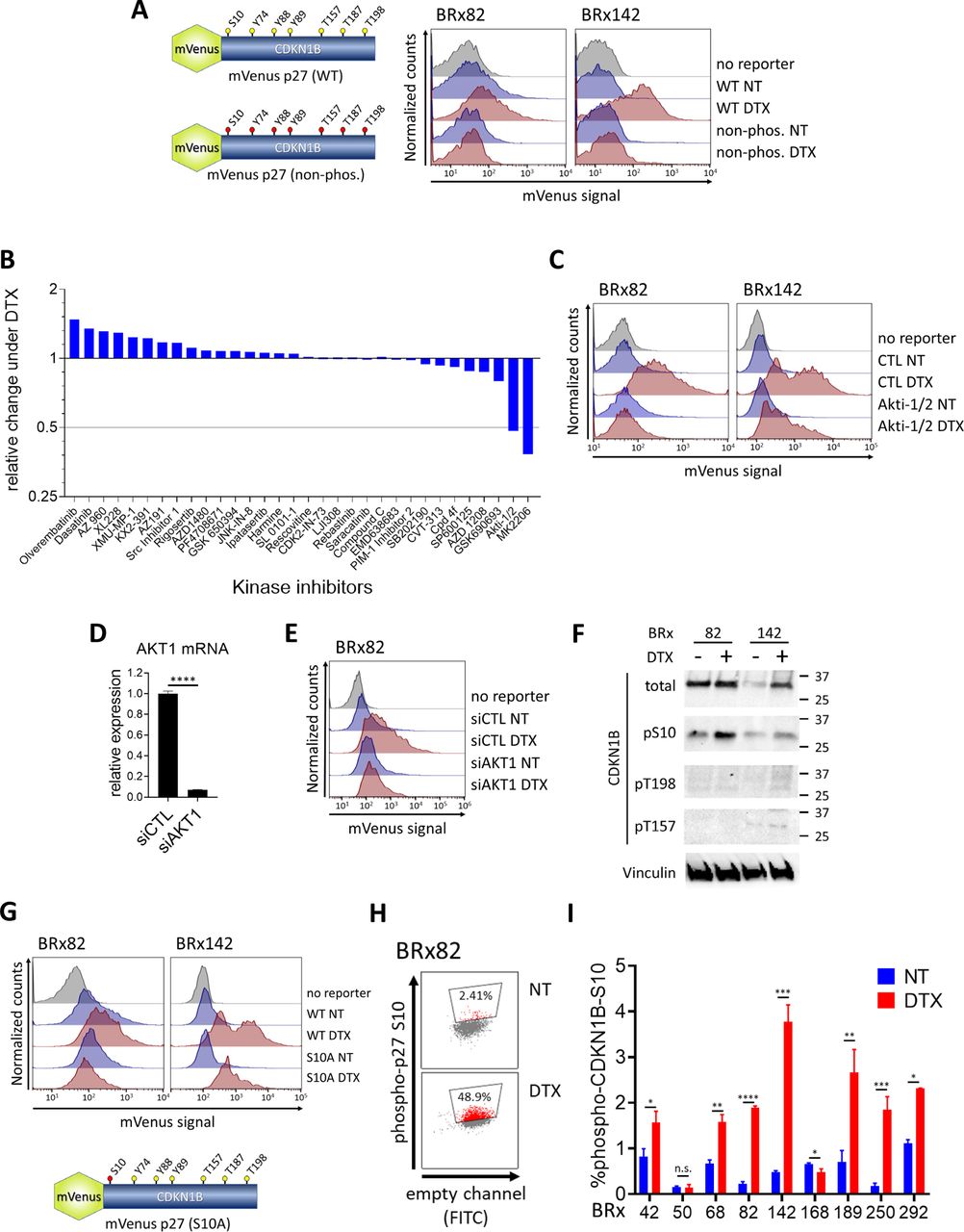
    5A: Stabilization of mVenus-p27 reporter construct following DTX exposure. Left: schema of the reporter, fusing a fluorescent tag (mVenus) to the catalytically inactive CDKN1B coding sequence of CDKN1B, driven by the CMV promoter. Phosphorylation target residues are shown in the wild-type (WT) reporter, all of which are mutated to alanine in the mutant construct (non-phos.) Right: Increased mVenus fluorescence signal (flow cytometry) following treatment of CTC cultures (BRx-82, BRx-142) with DTX (10nM, 4 days), indicating stabilization of the reporter protein. Mutation of all 7 candidate phosphorylation target residues abrogates stabilization of the reporter. One of two biological repeats is shown. 5B : Waterfall plot, showing a kinase inhibitor screen to identify candidates mediating stabilization of the mVenus-p27 reporter, following treatment of CTCs (BRx-142) with DTX (10nM, 4 days). Among 32 kinase inhibitors targeting 15 kinases previously implicated in stabilizing CDKN1B, two compounds targeting AKT (Akti-1/2 and MK2206) suppress DTX-mediated stabilization of CDKN1B. Bar graphs represent the ratio of the percent reporter-positive cells exposed to DTX along with inhibitor as a function of the percent reporter-positive cells exposed to DTX alone. 5C: Suppression of CDKN1B reporter stabilization in CTC cultures (BRx-82, BRx-142) treated with DTX (10nM, 4 days) in the presence of the AKT inhibitor Akti-1/2 (100mM). mVenus fluorescence signal in live cells was measured using flow cytometry, with one of two biological repeats shown. 5D: Knockdown of the AKT1 isoform using siRNA transfection in CTC cultures (BRx-82) stably expressing the CDKN1B reporter. Bar graph (mean ± SEM), with p-value was calculated using two-tailed Student’s T-Test (**** p<0.0001 5E: Suppression of CDKN1B reporter stabilization in DTX-treated CTCs (BRx-82) following transfection with si AKT1 , compared with siControl. Shown is one of two biological repeats. 5F: Western blot analysis showing increased phosphorylation of one of the three AKT phosphorylation sites on native CDKN1B protein, serine-10 (S10), in CTC cultures (BRX-82, BRx-142) following treatment with DTX (10nM, 4 days). The other two AKT mediated phosphorylation sites (T198 and T157) are less evident by Western blotting . Total CDKN1B protein levels are shown (with and without DTX exposure), along with Vinculin expression (loading control). 5G: Mutation of the CDKN1B S10 residue within the mVenus reporter is sufficient to reduce DTX-mediated protein stabilization. The position of the serine 10 residue (mutated to alanine) is shown in the schema (mVenus p27 (S10A). Mutation of S10 reduces CDKN1B stabilization in CTCs (BRx-82, BRx-142) following DTX exposure (10nM, 4 days), compared with wild type (WT) reporter. mVenus fluorescence signal in live cells measured using flow cytometry, with one of two biological repeats shown. 5H: Flow cytometric analysis, showing increased subpopulation of CTC cultures (BRx-82) with detectable endogenous phospho-serine 10 (S10)-CDKN1B protein, following DTX exposure, compared with untreated cultures (NT). A representative scatter plot is shown. 5I: Bar graph, showing quantification of the fraction of per pro CTC cultures (BRx-42, BRx-50, BRx-68, BRx-82, BRx-142, BRx-168, BRx-189, BRx-292) with phosphorylated endogenous Serine 10 (S10)-CDKN1B. Percent S10-CDKN1B positive cells (mean ± SEM) following DTX exposure or untreated (NT) is shown, with p-value calculated using two-tailed Student’s T-Test (* p<0.05, ** p<0.01, *** p<0.001, **** p<0.0001).

    Journal: bioRxiv

    Article Title: CDKN1B (p27 kip1 ) enhances drug tolerant persister CTCs by restricting polyploidy following mitotic inhibitors

    doi: 10.1101/2024.02.20.581202

    Figure Lengend Snippet: 5A: Stabilization of mVenus-p27 reporter construct following DTX exposure. Left: schema of the reporter, fusing a fluorescent tag (mVenus) to the catalytically inactive CDKN1B coding sequence of CDKN1B, driven by the CMV promoter. Phosphorylation target residues are shown in the wild-type (WT) reporter, all of which are mutated to alanine in the mutant construct (non-phos.) Right: Increased mVenus fluorescence signal (flow cytometry) following treatment of CTC cultures (BRx-82, BRx-142) with DTX (10nM, 4 days), indicating stabilization of the reporter protein. Mutation of all 7 candidate phosphorylation target residues abrogates stabilization of the reporter. One of two biological repeats is shown. 5B : Waterfall plot, showing a kinase inhibitor screen to identify candidates mediating stabilization of the mVenus-p27 reporter, following treatment of CTCs (BRx-142) with DTX (10nM, 4 days). Among 32 kinase inhibitors targeting 15 kinases previously implicated in stabilizing CDKN1B, two compounds targeting AKT (Akti-1/2 and MK2206) suppress DTX-mediated stabilization of CDKN1B. Bar graphs represent the ratio of the percent reporter-positive cells exposed to DTX along with inhibitor as a function of the percent reporter-positive cells exposed to DTX alone. 5C: Suppression of CDKN1B reporter stabilization in CTC cultures (BRx-82, BRx-142) treated with DTX (10nM, 4 days) in the presence of the AKT inhibitor Akti-1/2 (100mM). mVenus fluorescence signal in live cells was measured using flow cytometry, with one of two biological repeats shown. 5D: Knockdown of the AKT1 isoform using siRNA transfection in CTC cultures (BRx-82) stably expressing the CDKN1B reporter. Bar graph (mean ± SEM), with p-value was calculated using two-tailed Student’s T-Test (**** p<0.0001 5E: Suppression of CDKN1B reporter stabilization in DTX-treated CTCs (BRx-82) following transfection with si AKT1 , compared with siControl. Shown is one of two biological repeats. 5F: Western blot analysis showing increased phosphorylation of one of the three AKT phosphorylation sites on native CDKN1B protein, serine-10 (S10), in CTC cultures (BRX-82, BRx-142) following treatment with DTX (10nM, 4 days). The other two AKT mediated phosphorylation sites (T198 and T157) are less evident by Western blotting . Total CDKN1B protein levels are shown (with and without DTX exposure), along with Vinculin expression (loading control). 5G: Mutation of the CDKN1B S10 residue within the mVenus reporter is sufficient to reduce DTX-mediated protein stabilization. The position of the serine 10 residue (mutated to alanine) is shown in the schema (mVenus p27 (S10A). Mutation of S10 reduces CDKN1B stabilization in CTCs (BRx-82, BRx-142) following DTX exposure (10nM, 4 days), compared with wild type (WT) reporter. mVenus fluorescence signal in live cells measured using flow cytometry, with one of two biological repeats shown. 5H: Flow cytometric analysis, showing increased subpopulation of CTC cultures (BRx-82) with detectable endogenous phospho-serine 10 (S10)-CDKN1B protein, following DTX exposure, compared with untreated cultures (NT). A representative scatter plot is shown. 5I: Bar graph, showing quantification of the fraction of per pro CTC cultures (BRx-42, BRx-50, BRx-68, BRx-82, BRx-142, BRx-168, BRx-189, BRx-292) with phosphorylated endogenous Serine 10 (S10)-CDKN1B. Percent S10-CDKN1B positive cells (mean ± SEM) following DTX exposure or untreated (NT) is shown, with p-value calculated using two-tailed Student’s T-Test (* p<0.05, ** p<0.01, *** p<0.001, **** p<0.0001).

    Article Snippet: CDKN1B and scrambled control shRNA in the pLKO.1 lentiviral backbone vector were purchased from the TRC shRNA library (Broad Institute).

    Techniques: Construct, Sequencing, Phospho-proteomics, Mutagenesis, Fluorescence, Flow Cytometry, Knockdown, Transfection, Stable Transfection, Expressing, Two Tailed Test, Western Blot, Control, Residue